Showing posts with label CV. Show all posts

Wednesday, 18 May 2016

Preparing for summer: CV tips, internships and holidays

At the moment all I can think about is exams and coursework, so in an effort to use this blog as a distraction from all that I thought I would write about something that we are all looking forward to; summer!

For those of us doing Masters Degrees, summer isn’t really the same because we don’t hand in our thesis until September. This means that the break isn’t really a break from work at all!

However, we still get to take time off and one of my favourite pastimes at the moment is booking this summer’s holiday to Italy with my partner. We are going to fly into Milan and then spend a week visiting Venice, Florence and then Rome before flying back to the UK.

I have spent absolutely hours looking at different websites trying to find the best value accommodation, which is no easy task given how popular these places are as tourist destinations! I have managed to find some gems by using AirBnB and looking at hostels on the outskirts of the cities close to the trains which means that you save a lot of money but only have to travel for ten minutes or so to be in the city centre, which I think is a worthy trade off!

After this little roam around Italy I’m heading to Alderney for eight weeks to work for the Chief Executive of Alderney council. If you haven’t heard of Alderney don’t worry, I hadn’t either before this opportunity presented itself! It’s a tiny island (population around 2,400) just off the north coast of France and you can only get there by plane from Southampton, rather conveniently for me.

I honestly don’t really know what to expect when I get there; they haven’t had an intern before but there is the promise of some really very interesting work to be getting on with so I’m pretty excited.

Summer internships are crucial for future jobs and if you haven’t managed to find one already, keep looking. The University hires hundreds of interns over the summer to work on various projects, and your personal tutor is worth talking to because they might know of something interesting that’s become available, or even have some work for you to do themselves!

As well as all this I am also preparing to start working for the Office for National Statistics in October. It seems crazy because I applied way back in November of last year and have only recently been offered the job and assigned a start date. Having a job sorted for when I finish everything is rather wonderful because it takes a lot of the stress out of summer.

However, if you are only just starting to look around, here are some useful tips:

1. Discuss your CV with your personal tutor before you finish university for good!

2. Apply to as many jobs as you can find, even if you don’t have all the required experience. Filling in applications is great practice as many employers now provide feedback on your application.

3. Phone up the person in charge of hiring new recruits and ask them for more information about what they are looking for. Sometimes web descriptions of job postings can be irritatingly vague and speaking to someone about what they want can be really helpful, and can help you decide whether it is something you want to do.

4. Sign up to LinkedIn. While there are discussions about whether or not it is beneficial, it’s free and can’t hurt. Plus it’s essentially an online CV which can be helpful when filling in job applications because you can just copy and paste sections from it!
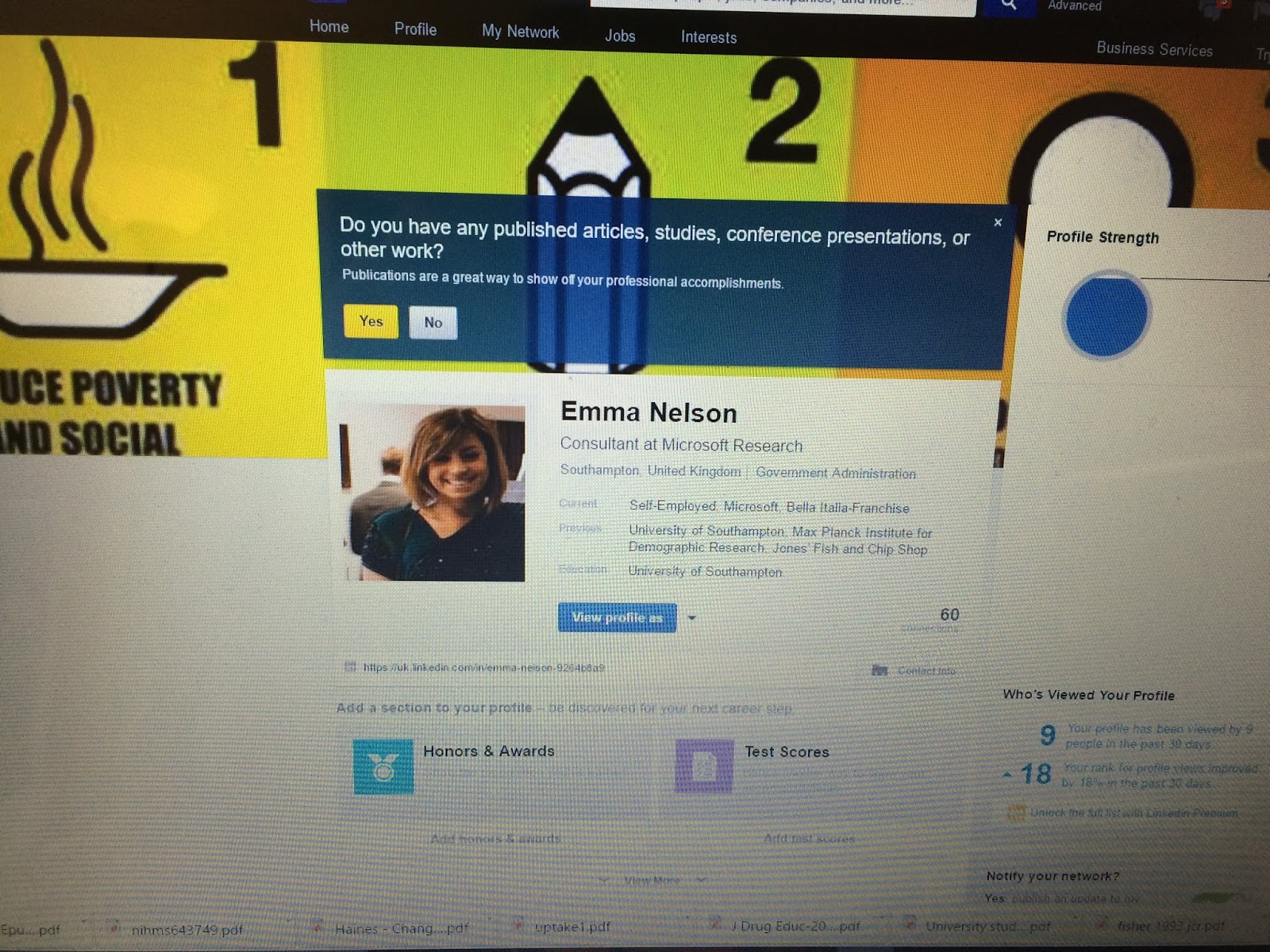


Plus filling in the profile is a nice way to distract yourself for an hour


My best advice is to do something awesome over summer because, particularly for us postgrads, it’s probably the last chance to have a few totally relaxed weeks without having to worry about work for the rest of our lives – which is a pretty terrifying thought!


Cake – because it’s the only thing keeping me going right now!


Good luck to everyone still working on their exams. Don’t panic because it will all be over soon!

Emma

Friday, 22 April 2016

How being a ‘Life at Southampton’ Blogger has made my university experience

It is strange to think that it was over a year ago I applied to become a blogger for the University of Southampton, and now the time has come to recruit for new writers! How time flies by.

Thinking about the fact that my stint as a working blogger is coming to an end has made me contemplate just how much of a tremendous impact the job has made on my life here at Southampton.

At the same time, I’d like to encourage as many people as possible to apply for this life-changing experience!

So, why is being a blogger so great?

Blogging has boosted my confidence


It has given me the voice and the confidence to approach new people to learn about new things. The job requires you to come up with interesting content regularly. When I am running out of ideas to write about I have found that reaching out to people around me and checking out what they are getting up to makes for exciting content and an enjoyable experience of learning on my part. Not only has this built up my network here at the University, but it has also helped me make new friends.


Getting to know Enactus Southampton!


Meeting with AISEC and other societies for SUSU’s Culture Week. We chatted about activities for guests at the International Culture Night and the Global Village


Blogging has taught me the benefits of introspection


The more you blog about your life, the better you see and appreciate details that you take for granted. They say that your time at university creates some of the best years of your life. Taking some time to be mindful about what is happening right now has not only helped me understand myself but also get a better idea of where my life is going beyond Southampton. What’s more, this reflectiveness and the constant need to generate ideas has helped me think clearer.

Blogging has challenged me to be more disciplined


We all have to do something challenging at some point. Before coming to university I was not the best person at disciplining my use of time. Procrastination was my enemy, indeed. In addition, I can have the tendency to be lazy about connecting with people and keeping schedules. Since becoming a blogger I have an incentive to show up, meet with people and write.

At the same time, I have had to challenge myself to become better at time-management skills. This is essential as, in order for you to have a social life at university as well as managing academic work, you need to really have a good grasp of how you spend your time.


Holding the Filipino Society’s first Halloween party


With the FilSoc committee

Blogging looks good on your CV!


A project like this can really sell your CVs in job applications and helps with employability. Having the title of a “professional student blogger” on your CV makes you stand out from the pack. It shows that you learnt something outside of academia during your time at university.

Maintaining a blog also shows commitment to employers. Not only this, but because the theme of the blog is geared on student life, it says that you are emphatic to your audience and mindful about current events.

Blogging helps other people


This digital age is a wonderful era to live in. Your content can reach many people from different continents and cultures. The idea that your personal thoughts touch other souls is gratifying to say the least.

By frequently sharing an inside view of what life really is like as a student, and openly sharing moments about your life, you help potential university undergraduates decide if this is really the path that they want to take after high school or sixth-form college.


What I am up to now: obligatory dissertation hand-in photo! Can you say I 'got diss'?


Applying for the position


So, if you want to do something challenging, fun and generally make your student experience a hundred times better, you can do so by applying to be a blogger!

As my time here at Southampton is nearing its end, I can honestly say that I am very proud of becoming a Life at Southampton blogger!

Rylyn

Wednesday, 9 March 2016

Change Your World and International Women’s Week

March is inspirational month here at the University of Southampton. The University is currently celebrating International Women’s Week (IWW) 2016. IWW will see programmes rejoicing the contributions of women across the world. In addition to this, SUSU is hosting ‘Change your World Week’ ; a week jam packed with events to inspire personal sustainability and social progress.

All of these events have made me deeply consider what “progressive” means and how this whole idea materialises in real life. Yesterday was International Women’s Day, the whole point of which is to cast off the taboo of feminism. It sheds light on things that are standing in the way of true equality. It’s about fostering recognition for the incredible contributions and achievements women have championed despite social, cultural and economic barriers. That’s the difference between misandry and feminism and the difference between social stagnancy and what is progressive.

A few days ago I had the pleasure of attending a panel event called ‘Inspiring Women’.

‘Inspiring Women’ is an annual event held by SUSU which features a line-up of successful women who are in leadership positions across varying fields. The night consisted of a panel telling us about what they have learnt on their career journey to reaching the top. The aim was to encourage you to accomplish your ambitions. I cannot stress how valuable the night truly was for everyone who attended, both men and women alike.


Before the event started. Smiling from the complementary canapés!

Challenge your perceptions


One of the women who spoke was Lynne Parker who owns a comedy company called Funny Women. They run comedy workshops for workplaces to aspiring female comedians from Edinburgh to Brighton. Lynne set up the company when someone told her the reason why only a few women are in comedy is because women simply aren’t funny. Nearing her 60th birthday, Lynne asked the audience to challenge their perception of older women – just because someone tells you that you may not look the part, doesn’t mean they are right!

Just get over yourself!


With over 10 years of experience working in film and television, Emma Smithwick was the youngest in the panel. It was surprising when Emma said she actually did French and Law at university and even worked in the law industry in France before she decided to get into creative media.

With effort and perseverance she found herself in the BBC working on Saturdays and Sundays on other people’s productions for free just to get experience. She even had a part in the creation of one of my favourite films, Little Miss Sunshine, by being the first to see the potential in its script. A few years later she found herself working on set of the popular Channel 4 show Hollyoaks, and was offered the position of executive producer. She turned it down a couple of times, thinking that they must have been mad to have even thought about offering it to her.

Then Emma told us about a networking event where a lady spotted her in the corner, hiding away from the rest of the crowd. The lady apparently approached her for friendly chat. After mentioning her fear of networking the lady, in all of her well-meaning, said “No one in this room is singling you out and thinking ‘we don’t want to talk to her’… we’re all strangers here so take this fear and just get over yourself!”

Sometimes you are the only barrier to your own success and sometimes you just need to get over yourself! Emma took the job with Hollyoaks in the end.


All were welcome to attend; it was nice to see daughters coming to the event as well. 

Some of the lessons I learnt from the panel are things I will take away with me for a long time. Younger people can especially benefit from them.

You’re not an imposter


Paula Claisse, a regional head in the South for KPMG, was the last of the panellist and she gave what is quite possibly the best advice about confidence. She pointed out that you may sometimes dismiss your success through luck or timing or as a result of deceiving others into thinking you’re good enough. In actual fact, you are good enough. This inability to accept accomplishments is actually quite common among high-achieving women and men, and has been coined as Impostor Syndrome.

It helps knowing others experience it too. Now that I know this is a problem, I am going to find more time to look at things from a wider perspective so I can better accept what I have done well and where I can do better.

The women in the panel were TV producers, company ownders and more. However, they were also mothers and sisters. They were different ages, and different shapes and sizes. What the event has really highlighted was that reaching the top does not necessarily equate to money, but can mean doing what you enjoy or doing what you’re great at.

Look out for the event again next year and I guarantee you that you won’t be disappointed.

Rylyn

Wednesday, 10 February 2016

What makes me special? Writing an internship application.

At one point, every student will have to sit down and start writing applications. I find myself in that situation right now and as I try to puzzle together the right way to explain why I’m the best fit for this internship or this exchange-program, I’ve decided to run to my ‘productive procrastination’ method – blogging.

In all seriousness, how do you explain that you want a position and you are a great fit for it without sounding almost desperate and extremely clichĂ©? How do I write an application without much work experience to fall back on? How do I find a suitable internship for me? I’m not an expert, but I have collected a couple of points that have helped me.

1. Collect your thoughts 


I’m laughing a bit about myself for writing this, because this is exactly what I try to do, but somehow always get distracted. Nevertheless, collecting your thoughts is important. The internship I’m applying for now, for example, had a couple of questions you were supposed to answer. Instead of just writing as I go, I have made a little mind map about positive attributes I have, which will be relevant to this particular internship. This method also includes collecting thoughts about why this particular attribute is relevant.

2. Inform yourself 


There are loads of possibilities out there in terms of internships, but if you just apply for the first ones you find, you might not find the most suitable internship for you. Pop by the Careers and Employability services and ask what they have available, check what is available through your course and think outside the box. Valuable work experience is everywhere.

3. Lacking work experience 


Make up for it by explaining what skills your course/volunteering/societies have given you. These are things we often forget, but even having done sports in the past can be valuable. For example, playing handball taught me how to play on a team and possess good team spirit, whilst playing tennis has taught me to work independently. Through my course we learn extensively about critical thinking, how to see cases from new perspectives and how to discipline ourselves/plan ahead and take responsibility for getting work done.


A picture of campus is always appropriate – especially when the light (and weather) is this nice as it was last week.


These are just a couple of things that might help when you write your applications. You might have read fellow blogger Emma’s blog post on how to tackle an interview. As she also mentioned, the University’s Career and Employability Services located in Building 37 on Highfield Campus are one of the many perks of being a student here at Southampton. You can go there to get advice on your CV, writing your application, what you can do with your degree, how to turn your idea into a business and so many other things. They also run regular workshops which are definitely worth having a look at.

Alexandra

Thursday, 28 January 2016

My tips for video interview success

This week I had the experience of having my very first ever video interview. Video interviews are becoming a more common way of screening potential candidates for jobs. It’s quicker, cheaper and can be conducted literally anywhere in the world!

It took a while to get used to pretending my camera was a real life person but at the end of it, I actually found that I felt more comfortable talking about myself this way than in face-to-face interviews.

My video interview didn’t have another person asking my questions at the other end. Instead, questions were given to me on the screen and I was given time to record my answers.


Based on the questions that I got asked, I have listed above what I think the recruiter wanted to gauge from me.


In my experience, depending on how specialised the position that you’re applying for is, most recruiters are becoming less interested in technical knowledge. What they want to know is whether or not you can fit into the culture of the company. Most importantly, they want to know how easily you can learn and adapt on the job – this is much more important than sounding as smart as Einstein.

My insider tips


1. Take the video interview seriously and dress as you would for a face to face meeting. 

You will feel more powerful and this will transpire when you speak. You might think that you can get away by wearing a crisp shirt on top and your pyjamas as bottoms but it would do your confidence a favour to really dress to impress. 

2. Do research on potential questions that may come up based on the position you’re applying for.

Why don’t you check YouTube for other people’s video interviews so you have an idea of how best to conduct yourself? Better yet, why don’t you attend a careers interview workshop? Check out our Careers and Employability website for events to help you.

3. Familiarise yourself with the technology.
  • Is the webcam/microphone working? Don’t leave it last minute to check.
  • Can you stop and start the interview or will you lose time by doing this? My interview allowed me some time to read the question. Afterwards I was free to start the recording of my answers.
  • Are you allowed breaks? In my experience, I wasn’t. The idea is to emulate a real life interview but merely to exploit how technology makes it quicker and cheaper to screen candidates.

4. Try and locate the fastest internet speed you can get. 

This affects the quality of your video and ultimately how the recruiter will perceive you. The University’s Eduroam connection has never failed me. If you’re having trouble getting hold of a webcam, Hartley Library provides laptops with a microphone and camera. If you need a quiet room to record your interview, you can book a library room here. Of course, you can also complete the interview in the comfort of your own room! Just make sure you tell your housemates that your life depends on their quietness for the next hour or so…

5. Do a trial run.

Skype a friend before recording so you can ask for feedback on how close you should be to the camera and any other adjustments to make such as lighting and sound. I found that a plain white background for the video was enough. Too much going on in the back takes the attention away from you.

My experience in retail job interviews


As a student, it helps to have extra income from a part-time job whilst doing a degree. I work one shift a week in retail and that is enough to pay for my weekly food shop which is fantastic. My video interview was for Transport for London but I have had more experience being interviewed for retail positions. It’s different in a sense that they are done in person but incredibly similar in a sense that most of the questions I’ve been asked want to know how easily I can fit into the culture of the team.

If you’re thinking of applying for a part-time job in retail, here are some things that my manager has told me she keeps in mind when interviewing candidates:


Retail is very much team based and customer facing. Typically, employers want to know if you are warm and welcoming to new people, if you can sell products well and if you can learn on the job quickly. Retail is also busy and fast paced. I’ve found that it’s all about using your intuition and not relying on the manager or supervisor to tell you what to do all the time. For example, if I see a spillage on the shop floor I use my intuition to follow the right clean-up procedure and not wait for my manager to ask. One other thing is that retail managers want flexible recruits. Sometimes, your colleagues will get ill or someone can’t turn up for their shift. Your CV will get a guaranteed tick if you are flexible and open to short notice shift work.

In my experience, practice makes perfect if you want to succeed in that interview. Take a few hours to search online what kind of potential questions will come up based on the technicalities or competencies needed for the position you’re applying for. Ultimately, an interview is your opportunity to bring to life your CV. If you’ve got it – flaunt it. Don’t be shy to sound passionate.

If you have had a video interview, let me know how it went in the comments below. If you have one coming up, best of luck to you!

Rylyn

Thursday, 21 January 2016

Getting back into it - the start of the final semester

It’s been several days now since my last deadline passed, and we’ve still got a few days before the new semester kicks into play, leaving life somewhat adrift. It seems I’ve become caught in some strange sense of limbo; the twilight zone between assignment work and the return of lectures, seminars and general structure.

To let this time slip on by seems almost too wasteful. It may be important to get some serious rest in before the start of the new term - what promises to be the busiest yet - but equally, this little pocket of dead space has proven mighty useful for ticking off a number of things I’ve been pushing myself to do, but never quite got round to. More pressing matters always seem to end up getting in the way, but with the deadlines now all pushed to one side, the hunt was finally on.


Those little green ticks have unleashed a whole new world of nothing


Jobs


Yeah, I used the ‘J’ word. This week I finally addressed that ominous spectre that seems to somehow float above the heads of all third-year students, taking some of this spare time to polish up my CV and even send off a few application forms. I won’t lie, gathering up the energy to start seriously thinking about my future hasn’t been particularly easy, but once that first form was perfected and sent off into the ether, everything became that little bit more manageable.

A quick flick through the University’s Careers and Employability Service website also proved mighty useful, giving me a necessary kick in the right direction whilst also letting me know about upcoming employability events. Knowing that there’s plenty of recruitment fairs between now and the summer helped ease a few worries for sure.

Dissertation


Oddly enough, I actually owe a lot to the fact that I have to hand in the draft of my dissertation in just over a month (a slightly scary thought now that I’ve seen it written down). Between all the research and garbled rewriting, dissertation work has not only kept me sane, but it’s also helped to maintain at least a sense of focus in my otherwise structureless days.

Occasional meetings with my tutor ended up encouraging me to head on back over to Avenue Campus, which still looks just as pretty as it did last year, despite the sudden sub-zero temperatures. The actual work itself helped me to feel productive on days when otherwise, time would have simply slipped on by. Apparently this whole dissertation thing isn’t nearly as terrifying as I’d first heard. In fact, I think I might be becoming rather fond of it.

Semester two


Otherwise known as ‘the final semester’ (cue dramatic music, thunder, lightning etc.). Suddenly having no lectures and no deadlines for a bit has of course left me plenty of time to plan out how I’m going to spend my final term here at the University.

Drawing up a timetable for my next set of modules seemed like a good way to start, but from there it seemed to mostly dissolve into a Southampton bucket list - something I’ll no doubt share with you all further down the line. Rest assured though, SURGE, The Edge and SUSUtv will hopefully remain heavy fixtures in the coming months.

It’s been a strange few weeks, but with lectures returning really rather soon, I’m sure some much needed routine will follow just as easily.

Ben

Wednesday, 30 September 2015

Making the most of my last undergraduate year

Last year I had a chat with a representative of PwC. It was an informal CV consultation in an event set up by the University’s Careers and Employability team. I had no obligation to apply for the employer after I graduate - it was simply an opportunity to have an interactive one-on-one session with someone who was hiring. What we spoke about during this meeting has had a profound impact on my last year as an undergraduate student.

As we chatted through my CV, we spoke about how my grades and job history were good, but there was a space that was missing a lot of writing: extra-curricular activities. It is true that your grades are crucial to your job search. At the same time, however, so are your activities outside of academia. As cheesy as this may sound, it indicates to employers how wholesome you are as an individual and thus plays a crucial part in what give you an edge as an applicant.


Never managed a team before? There is support out there for you. I got this book from the Academic Skills  shelf on the third floor of Hartley library.

So, in light of this, I became President of the Filipino Society. I had never managed a society before, let alone had been part of a committee. I am still getting used to delegation and event planning, but with the help of the team I hope to make this year a successful one for the society. Our first event for the year was, of course, the Bunfight.

Planning this turned out to be quite enjoyable, and we decided that the best way to introduce newcomers to Filipino culture is through the stomach.

So, we got sweets!


The Filipino Society’s stall at the bunfight. The tubs on the right hand side are Filipino sweets and chocolate.


Our aim is to bring Filipinos together and to promote our culture – anyone can join, regardless of nationality! But I must state that the sweets weren’t to lure people into signing up for the society. We decided to have them out as it was a good conversation starter and, well, who doesn’t like treats anyway?

We also chatted to prospective members about other events we are planning to hold such as Karaoke nights, Movie nights and last but not the least, our Filipino themed Halloween Party!


Our poster/invite that we handed out at the Bunfight!


The Freshers' Week Bunfight was exceptionally busy this year. Within the first hour we must have chatted to over 100 students! I also had the time to look around other societies’ stalls, and I was surprised to find out about groups that I never even knew existed.

Are you a fan of Harry Potter? Game of Thrones? Did you know that Southampton has a Fandomonium Society where you can express your love for your favourite books, TV shows and more? Amazing!


The Bunfight in full swing! (Credit to University of Southampton’s twitter page)

 Of course there were perks to being a committee member and running a stall too…


The Bunfight pass allowed stall runners to skip the queue and have a wander through the stalls on their breaks!

I also attended the LGBT Society lunch at The Bridge. The purpose of the society is to provide a space for LGBT+ students to socialise with one another and express who they are free from judgement. I believe in this cause so I’ve also decided to join this year.


Me with the LGBT Society Committee


Looking back on my first time at the Bunfight, I realised how easy it was for me to sign up to too many societies. SUSU has over 300 different student groups, including over 80 sport clubs and 30 performing arts groups.

For me, it is far better to actively contribute to one or two clubs or societies than be a passive member of them all!

And so, the final countdown has started; I may have to be a bit more organised but the pleasure principle need not be lost!

Happy socialising!

Rylyn