Showing posts with label advice. Show all posts

Thursday, 8 December 2016

I chose #Southamptonbecause …it opened my eyes to what I could achieve

For me, it was more a matter of why not Southampton?

I’d visited five universities before submitting my UCAS application, but my heart was set on here when I saw the obvious passion from course lecturers and students alike.

Therefore, this post will answer some of the questions I wish I’d known the answers to before my first year - so hopefully it helps some of you to make a decision!


A snap of Highfield Campus! 


What makes our uni unique?


It may be a cliché but it’s worth saying - I truly believe that the University of Southampton is a special place to live and study. You only have to attend one of our Open Days in the summer to see the genuine satisfaction and enthusiasm of our students and the welcoming atmosphere on campus!

Furthermore, Humanities students have our own, picturesque Avenue Campus close to Highfield, so it’s easy to meet up with friends and coursemates regularly.


One of the weekly markets on the Redbrick


How is life in a halls of residence?


I know plenty of people who loved living in sociable residences like Montefiore and Glen Eyre, but the prospect of leaving home can be very intimidating. It brings back memories of not having wifi in our buildings and then feeling ever so slightly envious when it was installed a year later!

I can assure you that each year will be easier and more enjoyable when you find people with whom you have common interests.


The entrance to Avenue Campus


How difficult will it be to settle into my course?


This was one of my big concerns before starting my degree. Many students arrive having excelled in sixth form, but find it disconcerting that they are not alone in being talented in their subject area.

Fortunately, the lecturers on my languages course have been noticeably encouraging as they are distinctly aware of the step up.

Ultimately, though, everyone is in the same boat and the support network with course coordinators and personal tutors is always something I’ve appreciated here as you feel valued by your faculty.


Late afternoon on the Southampton Common!


How can I follow my hobbies beyond my degree?


The Bunfight in Fresher’s Week highlights the ever-growing diversity of societies on offer here. This means that you’ve got even more opportunities to get involved, whether it’s a new hobby or one that you’ve been practising for years.

I’ve relished being part of languages and Erasmus societies as well as playing tennis, badminton and 5-a-side football on the side. It’s this emphasis on inclusion which inspired me to take up running and in April, I’ll be running my second Southampton Half Marathon!


At a Southampton match (supporting Liverpool!) 


On a trip to Winchester Christmas market


Will I be employable after uni?


I may not have a job just yet, but I can state with absolute certainty that my university life has equipped me with a number of enticing life skills for employers, such as teamwork, communication and time management.

I’m not saying that this couldn’t be achieved anywhere else, but Southampton was the perfect fit for me in terms of location, course and hobbies so there’s no reason it won’t be the same for you too!

Thanks for reading and hope you’ll find my advice helpful!

Paul

Thursday, 3 November 2016

Checking in

In our second throwback post, ex-blogger and Computer Science graduate Robin Johnson shares what he's been up to since leaving Southampton, alongside some friendly advice.

Well… hello again!

Crikey! It’s hard to believe it’s been well over a year since I was bidding farewell to Highfield campus as a permanent home, wearing a pointy hat, collecting a thin paper scroll with which I could prove I’d graduated from the University of Southampton with an MEng in Software Engineering, stuffing four years’ worth of assorted paraphernalia into my parents’ cars (it was a lot!), and then riding off into the glorious sunset - or, more accurately in my case, the Northern drizzle!

Although plenty of time has gone by, memories of the wonderful place are as fresh as ever. It seems like merely weeks since the end of my quite unforgettable life at Southampton, as the time has shot by, having morphed into another incredible year of excitement, adventure, and equally tremendous tales.

Just as my time on the south coast never seemed to stand still, I’ve been lucky enough to land in a graduate life and job which has so far proven just as fast-paced, varied and exciting as the four years of higher education – and it’s similarly making the months just fly by!

Of course, it’s been somewhat impossible to stay away from the place where I learnt so much about the world, and throughout the year, I’ve been back to visit campus on a few occasions – after all, there are too many fantastic folk, and theatrical societies, at the University, not to!

It all still feels warmly like a second home, and although I now feel decidedly “old” when I go back, it’s still coloured with happy memories, friendly faces, and that brilliant communal spirit that makes it such a special place to learn about yourself, your course, and the world around you.

Braced with that infectious enthusiasm at University, which inspired me to try and pursue as many opportunities around my studies as I could (it took getting a First to convince my Mum!), I’ve tried to maintain this approach to life in the ‘real world’ ever since - although it’s ever so slightly more difficult when you pay council tax, have a full-time job, and need a regular sleeping pattern!

Through one way or another, I’m delighted to say I’ve found myself making a living and working in the vibrant setting of the capital city, London, accompanied by many of my friends from my time in Southampton, as well as plenty of brilliant new people. And, in news that will surprise nobody who read my previous articles, my job’s in the theatrical industry!


My ‘new’ home!


Having graduated and then visited the Edinburgh Festival Fringe for a third year in a row – it must be a tradition now! - I took a bit of time out to rest up, and consider my options. With a wide-reaching degree under my belt, which encompassed topics from programming to project management, and design to digital systems and applications, as well as numerous opportunities in media, performance and other creative applications afforded to me by the University and brilliant Students’ Union, my experiences in Southampton gave me plenty to consider moving forwards, as well as loads to try and cram into a two-page C.V.!


Directing in Edinburgh after graduation - there was still time for one more production with the University!


In the end, having spent a bit of time practising these skills in my own time, I decided to try and go for the creative industries which formed such an invaluable part of my University life, an interest which Southampton did so much to cultivate.

In doing so, however, I was acutely aware that the sheer flexibility of the degree I received from the University will allow me to move in other directions if necessary, and will stand me in good stead for future endeavours and adventures - whatever they may be!

One chance meeting at a careers’ fair later, and I’ve found myself working as an intern for a wide-reaching West End theatre organisation which has seen me so far:
  • work at the Olivier Awards at the Royal Opera House and West End Live in Trafalgar Square
  • attend and report from theatre press nights
  • work in editorial, ticketing and marketing
  • meet and interview plenty of household names (including, recently, Sir Ian McKellen and Sir Patrick Stewart!)
Needless to say, it’s been a surreal year!


Working on the red carpet at the Olivier Awards was a surreal, but incredibly exciting, experience!


 Reviewing the new Harry Potter play in the West End was another highlight!


I’ve been incredibly fortunate to be a part of such a brilliant organisation for the majority of the year, and I can’t thank them enough for the opportunities they’ve afforded me. With hopefully more fantastic experiences on the horizon, the future is certainly looking bright.

To future Southampton graduates, I’d just urge you, no matter what your aspirations, to absolutely go for it; you’ll find a way. And for those of you lucky enough to still be there: enjoy your time, make the most of it, and say “yes” to as many opportunities as you can; you never know where they might take you, both academically and personally.

Looking back on life at Southampton one year on, it’s strange to think that the journey I embarked on five years ago, as a nervous, shy first-year, has taken me to where I currently am. But I’m proud of the fact that the journey started at the University of Southampton; what a place to be!

Robin

Wednesday, 19 October 2016

How to cope with boredom

It is good to be back to England’s version of October and not Norway’s version. Norway’s version is a bit like this….


Layers on layers and wrapped in my big coat. 

I’ve had a quick weekend trip home to Oslo last weekend and as always I have enjoyed myself. Now, it is back to university and the workload starts catching up.

If you have found it boring only reading my blog posts for a while now, I’m happy to say there is no need to worry! The blog team is complete now and I’m not the only blogger anymore!

Talking about boring and boredom, how do you cope with being bored? Besides eating unhealthily and watching a season of Netflix? Despite having more than enough to do at University I still have my moments where I’m just bored and fancy doing something other than work. I’m a firm believer of good breaks and not only devoting all my time 24/7 to my studies.

I would like to share some tips on what to do if you are feeling bored. These are all student-friendly tips and some of them I dare to say are good for your mind and body.

Go for a walk! 


Walking is the best way to experience Southampton and it is good for your body and mind. Put some headphones in and find somewhere nice to go. Mayflower Park, Oxford Street, Ocean Village are nice destinations.


This is what you can expect down in Mayflower Park


Experience the British Art Show 8 on campus or in town.


You absolutely have to visit the John Hansard Gallery whilst a student at the University of Southampton, so here is a great opportunity to see an art show and visit the gallery. Besides, the British Art Show is presented at several different locations in town, so you can see more of Southampton!

Go to the gym or join a society. 


It is always a winner and going to the gym is probably my favourite way of having breaks during a hectic week.

Go out for a drink and a game of pool. 


Given that a year ago I couldn’t play pool I must admit the English love for pool has grown on me. Maybe visit some of the pubs I recommended to watch Euro 2016 a couple of months ago; they all have pool tables and I find it amusing that I can play pool for ages now without getting bored.

If you find that any of these tips require too much effort to leave the house I have also attached some less “active” activities you can do.

Less active tips:

1. Text someone backwards
2. Create a bucket list
3. Organise your sock drawer
4. Play a prank on one of your housemates/flatmates

Alexandra

Monday, 3 October 2016

Simple steps to fight Freshers' homesickness

I hope everyone who’s moved down to here for their first year of university has settled in and is starting to get used to their new lives here in Southampton. Since we are well into Freshers’ week by now, - in fact, lectures have begun! - I assume (if you are a fresher), you’ve learned a couple of things like:

• There’s a North vs South rivalry – I can’t really take sides in this, but I remember this being a thing that came up quite frequently during Freshers’ and the weeks following.

• If you’re an international student you have been asked “How are you finding England?” at least ten times.

And when lectures started you learned a few more things like:

• The buses are often packed first thing in the morning with everyone going to 9am lectures– so get to the bus stop early!

• First week is very nice and relaxing with a slow introduction into everything, then before you know it – deadlines and midterms are upon you!

• You sat next to loads of new people when lectures start and you introduced yourself … and instantly forgot their name.

However, moving away isn’t always easy and some might experience homesickness.

This is completely normal, just as it is also normal to move to university and not miss home. I’ve already written a bit about homesickness and how to cope with it in a previous post. However, I thought if you are in need of three simple tips on how to cope with homesickness especially at the start of a new academic year, this is what I have found to be very helpful:

1. Keep busy


Time flies when you have fun! Go out, see the city or join a couple of societies, there are endless of opportunities if you want things to do at the University. You are guaranteed to meet new people along the way and it will definitely be helpful if you are homesick and will also make Southampton and the University feel more at home.

2. Make your room feel like home


Halls are obviously very neutral, but it doesn’t mean it needs to stay like that. Fill your room up with pictures and other things that make it feel like your own space. Be aware of the rules of what you are allowed to have in your room; I know the rule about candles is a bit annoying especially for someone who loves scented candles, but an easy way around it is to buy a diffuser that smells nice!

3. Explore the city and its surroundings


If all you do is leave your halls to go to the campus and back it can be quite depressing and monotonous. Explore Southampton as much as you can! I’ve written about my favourite places to eat/go for a coffee here or what I love the most about Southampton – find your own new favourite places and things you love about the city.


Ocean Village in the city of Southampton - somewhere to visit away from campus!


I hope the first few weeks have gone well for you all!

Alexandra

Monday, 19 September 2016

What not to worry about when you start university

The first time I read the Life at Southampton blog was back in 2014, right before I was off for my first year at the University of Southampton. I read a blog post from former blogger Kristin about what she wished she’d known in her first year and it has inspired me to write a little post about what not to worry about before you go to uni.

I moved to England on the 20th of September 2014 (my birthday, for those who are especially interested!) with my whole life packed into two suitcases and one thousand questions, worries and scenarios made up in my head.

While I was crying my eyes out on my way to the airport it really hit me that I was going away – and for some stupid reason I kept talking myself down. ‘My English isn’t good enough’, ‘I can’t cook’, ‘I wont make any friends’, what if I fail my year?’ … the list continues. I wish I had someone then to tell me the following five things:

1. Everyone you meet is in the same situation as you!


It is so hard to forget, but it is true. Everyone will require their own time to adjust to moving and some might do this quicker than others. Be nice to everyone and have a positive attitude.


2. You don’t need to go out every single night, get ridiculously drunk and join 10 societies to make friends.


With that being said, going to some events during Freshers’ and joining a couple of societies are great opportunities to make new friends, but it is not the only way to make friends. You will make friends regardless of how much or little you go out during Freshers’.

3. If English isn’t your native language (like me) it will improve with time.


This obviously relies a bit on yourself as well; the more you practice speaking English the better it will be. It will be a hard change from the English you’ve learned at school to suddenly be surrounded by academic English everywhere – but you get used to it.

4. Cooking might be a challenge, but practice makes perfect.


Try and plan dinners with flatmates where you cook together or one person cooks and the others do the dishes. Like many other things, cooking at university is what you make it!

5. Re-sitting exams isn’t the end of the world. 


Having only ever known how resitting exams in Norway works, I was quite horrified when I learned that it is a lot stricter in England! Luckily, I have never had to re-sit any exams or a year, but it can happen to anyone. The University goes above and beyond to help you and to accommodate you if you have special needs for an examination, but the hard work needs to be done by you.

Along with my top five points, here’s some extra advice I’d like to give you for your upcoming move to University:


Don’t get stuck with one group. This is very easy to do, because you meet a group of people you like and suddenly you do everything with them. There’s nothing wrong with that, but remember to be open to meeting others as well – you will meet new people through every year at University.

If you don’t like your flat – try and change it. Most people get on very well with their flatmates and of all the people I know at university I only know one person who changed flat duringfirst year. It’s good to keep in the back of your mind that the possibility is there, because you will spend a lot of time with your flatmates, so it’s in everyone’s interest that you get along.

And one last thing…

During your first year, you will be told numerous times by fellow students that ‘First year doesn’t count’. Keep in mind that this is not entirely true:

1. You do need to pass your first year, meaning 40% or over in all core modules.

2. If you want to go on exchange the application process happens when you are in your second year and your first-year grades will be a part of your application; the most competitive places obviously require good grades. This also applies to you if you wish to apply for internships in your second year.

3. If you end your third year and are just between a First and a 2:1 your tutors might go back to your first year and see that you had such a good average that they will give you a First …or vice versa if you didn’t work at all.

Apart from that… just enjoy your Freshers’ and welcome to the University of Southampton!


Our beautiful Highfield Campus

Alexandra

Tuesday, 6 September 2016

My top five tips for making your phone University ready

With preparations for student life well underway, today I thought I’d take the opportunity to give some tips about how you make your smartphone/tablet ready for university.

These are my five most crucial apps or updates which make my day-to-day life during term time here at Southampton so much easier....

1. MySouthampton app 


This app is a  must. You can do everything on it, from browsing for free computers in the library to checking bus times, your timetable and email. You can even contact IT help and get a campus map up in an instant. I mostly use it to check my timetable and look up where certain buildings are (I still don’t know all the numbers by heart). You simply download it and use your Sussed username and password to access it!

Download MySouthampton

2. Blackboard app


This app, together with the MySouthampton app, makes everything that has to do with coursework and University logistics so much easier.

The Blackboard Mobile Learn app lets you check all your modules, module announcements, information, course content and more. It’s handy to have if you wish to have a quick look at the slides before, during or after your lecture, or if you want to have a look at the module handbook and you don’t have a copy of it to hand.

The only thing which I wish you could do with the app is checking your grades on it. Turnitin is not optimised for smartphones; so when your lecturer reminds you that you’ve received feedback on your coursework during a lecture and you don’t have a computer with you, you will have to wait to check your feedback.

Download the Blackboard Mobile Learn app

3. Configure your soton email


The University IT pages have a simple explanation to how you configure your soton email to your phone and computer. It makes it so much easier than having to log into Sussed everytime you want to check your email – and trust me; you will use your soton email a lot – probably more than you use your private email.

4. RefMe 


University was the first time I had ever encountered Harvard referencing and, although this app is by not a substitute for attending the library sessions about referencing, this app is a lifesaver for your bibliography and referencing adventures. It’s very easy to use and you can access it from your computer as well as your smartphone.

5. West Quay Cars and Radio Taxis app


We do have Uber in Southampton, but getting a car is nearly impossible and unlike many big cities, you don’t really save much by using Uber here. That’s why it’s good to have the apps for the big taxi companies in Southampton, which makes ordering a taxi easy.

The Students' Union also has a deal with these companies, which means that if you ever find yourself in a position where you don’t have money to get home, you simply hand in your student ID to the driver as a deposit and pay for the fare upon collection your ID from the Union's reception.


I hope these tips can come in handy for anyone starting University later this month, or maybe current students who still haven’t discovered RefMe!

Regardless, the above mentioned are without a doubt the apps I use the most during term time, so I hope this blog post is helpful for others too!

Happy app-ing!

Alexandra

Thursday, 1 September 2016

Life after Southampton: one year on

Over the next few months, some ex-Life at Southampton bloggers will be sharing their experiences as graduates. This week, Physics graduate James Gray looks back at his time at the University and updates us on what he's up to now.

A year has now passed since I graduated with a First Class Masters in Physics and so much has changed that I’m struggling to work out where to start.

I guess I should begin by recapping how this whole process started, so let’s rewind half a decade(!) to the moment when I first arrived at Glen Eyre halls in 2011, weighed down with suitcases and boxes and feeling thoroughly daunted about the next four life-changing years that were ahead of me.

I began, like many people, as a slightly timid but enthusiastic fresher, who was unsure of exactly what to expect. However, within days I had settled into my halls and within weeks I was thoroughly immersed in student life.

Throughout my time at Southampton I met a lot of new people and was exposed to a lot of new things, including blogging, the bizarre sport of Tchoukball and the even more bizarre world of quantum physics. However, my most important discovery was the field of medical physics, which, with a lot of hard work and perseverance, I managed to secure a job in after I graduated.


New Terrace in Glen Eyre Halls – my home in first year.


After a long summer break, which included trips to Amsterdam and the New Forest, I embarked on my chosen career. I am now a trainee medical physicist in an NHS hospital on the Scientific Training Programme and I have discovered that no-one seems to know what we do!

Medical physics is a broad area of healthcare science, which, as a broad generalisation, covers the use of radiation for medical purposes, including everything from creating radiotherapy treatment plans to testing x-ray equipment. It is a greatly varied job and one that patients ultimately rely on, even if they don’t realise it!


Having fun testing a UV cabinet looking like a riot officer.


My training follows a similar structure to that of a doctor’s; I have a long list of competencies and assessments to complete over three years, which relate to four rotations in my first year (these are ionising imaging, non-ionising imaging, radiation safety and radiotherapy), before I specialise into one of those four areas for the remaining two years.

I am currently undertaking my third rotation out of the four and when January comes I have chosen to specialise in imaging with ionising radiation, which encompasses work within both nuclear medicine and diagnostic radiology. I also have the opportunity to go on an elective; a 4-6 week work placement of my choosing, which can be anywhere in the world, so long as I can relate it back to clinical science! I am currently thinking along the lines of radiopharmaceutical research, development and production, but the options are limitless!

After three years of training, which includes another masters degree, I will have my final practical exams and I will then qualify as a state registered medical physicist – it’s a long and hard road, but I am more than up for the oncoming challenges!


Medical physics arts and crafts – making a radioactive test object that can be imaged on a gamma camera for one of my nuclear medicine competencies.


My job also involves bits of chemistry and biology – these are samples of broth I prepared to assess my aseptic technique when dispensing radioactive liquids.


My job involves a lot of testing medical imaging equipment, like this MRI scanner.


On a personal level, the transition from being a student to being an adult in the 'real world' has been one that I have enjoyed. One of the best changes is receiving a paycheck at the end of the month, making a new group of friends and realising that my time at the University of Southampton taught me many of the skills that I have needed in my professional life.

Since I graduated I have left home and moved into a lovely flat with my girlfriend in the quaint town of Haslemere, which lies on the borders between Surrey, West Sussex and Hampshire. Southampton is therefore not too far away and over the past year I have not been able to stay away! I have been fortunate in that I have friends who have stayed in Southampton and given me the perfect excuse to come and visit my old haunts, including Jesters, The Cowherds and, of course, the two Portswood ice cream parlours!


Highfield Campus in the sun on my last visit to Southampton.


When recently visiting the University and the surrounding city it has been hard not to feel overwhelmed with nostalgia. I felt it the most while walking around a sun-bathed Highfield campus, seeing all the student hubbub and feeling tempted to revert back to being a student and enjoying it all over again!

Therefore, my advice for anyone going into their last year at university is to really make the most of it – join a new society, get involved in everything you can and make use of all of the career resources that the University offers. However don’t feel pressured to focus on careers, because your final year of studying should still take priority. I only applied to two jobs in my final year, because they were the only opportunities I was truly excited about. Don’t waste your time on applications that don’t excite you, because you can’t replace passion and you should be following your dreams!

And finally, to all the new Freshers who are about to embark on their own Life at Southampton – I envy you! You will fall in love with Southampton and your time will fly by!

Thank you Southampton for everything! And thank you for reading this blog.

James

Read James's blog profile.
James's top posts:

Friday, 26 August 2016

Preparing for your adventure abroad: international students starting university

With the end of August approaching and Results Day already over,  most people who have applied for a place at university should now have some idea where they are going in September. I’m sure most people are happy that the wait is over, but then it hits you that it’s not long at all until the term actually start. Trust me, time flies!

Although this post is primarily for international students, there are definitely some tips to pick up for those who aren’t international students, but are still starting university next month. If you are in need of some packing tips, there are plenty of past blog posts which you should have a look at – and stay tuned, there will probably be some more in September. As for how to best prepare for University when you are an international student, here are my tips:

1. Get a notebook and treat it like your bible

Starting university means there will be tons of new pieces of information and not to mention dates you need to remember. Getting a notebook or just having some sort of system where you can write all of this down will help you a lot more than you think. Write down all the important dates like; when you'll be moving into halls, flight details, airport connection, campus introductions, Freshers' Week and your halls of residence address.

A packing list, what you need to buy/get done before moving, possible modules you want to take, who your academic tutor is are also things your notebook should include. In addition to a notebook, I got a little diary in which I wrote down all my expectations and fears about moving abroad and I kept writing in it consistently until my second year. Its already fun to see what I said in my first year, and I know it will be funnier in 10 years to look back at. Hopefully I’ll continue to write in it as I now go into my third year!

2. Orientate yourself on what the university offers

As an international student, the University offers a Meet and Greet service to pick you up from the airport and help you with the most basic things when you move to England; like opening a bank account etc. These things often start a couple of days before the official move-in weekend is and you do have to sign up for it. I was very lucky to have my dad accompanying me when I moved over, so I didn’t use this service. I lived with a couple of other international students who did use it and they were very pleased as well as they had set up an bank account before term started – a couple of months into term it hit me I should probably open a bank account in England, which is easier said than done, hence my next point...

3. Bank account, mobile number, doctor and national insurance number. 

When you move into halls you receive everything you need to register for the University health service and (as you quickly will find out) the queues to hand in this on campus are MASSIVE during the first few weeks. If you don’t fancy waiting in the line for hours, it is good to know you can register at any point during term. The same goes for setting up a bank account, getting a UK sim-card. etc. However, doing some of the “hard” work prior to moving is an idea. It is not really hard work, but orientate yourself online on what bank accounts are available, what are the fees and what documents you will need.

The same goes for getting a UK sim card; you can save a lot of money by checking all the different operators’ bundles and deciding if you want pay as you go or a contract. A contract means you need a bank account in a British bank, so it all goes hand in hand. A National Insurance number isn’t applicable to everyone, but if you intend to work you should get one. I signed up to be a student ambassador and when the payment form came later I realised I didn’t have a NI number and it takes a bit of time to get, so again if you intend to work find out what you need.


Moving into Mayflower Halls at the start of my first year!


4. Free up space on your phone

Not only for the hundreds of pictures you will take, but to download Skype, Viber, Whatsapp or whatever other apps you use to call home. Homesickness can happen to any of us regardless of whether we move 10000 km or 100 km from home. Luckily we have so many ways of communicating with those at home if you were to become homesick. If you, like me, have a mum who doesn’t quite understand her phone, downloading this for her and setting everything up before you leave is a good idea!

5. Join the official University of Southampton Freshers' groups on Facebook. 

This way you can find people doing your course or living in the same halls as you, already before you come to Uni. It is also a great source to find out about what events are going on during Freshers' Week. People use these groups frequently to ask questions, so you might find some extra useful information there and if you have questions yourself it is a lot easier to ask them there as you will get a reply faster than writing an email. These groups stay relevant throughout the whole year, and they are regularly updated.

I hope this was helpful and I wish everyone starting university next month the best of luck!

Alexandra

Monday, 13 June 2016

Moving out: what to do with your unwanted clothes and belongings

Wow – June is here already and I could not be happier to have some time to chill out and enjoy the sunshine. With the sunshine comes clothes shopping! Since my wardrobe was full of warm grey and brown winter gear I decided to splurge a little bit on some colourful tops and summer dresses.

However, once I brought them home I realised I had a serious problem – my wardrobe was literally bursting. Now, one solution that occurred to me was to buy more furniture; however that isn’t really an option given the tiny size of my flat so I had to think of a better storage solution!

The answer came from my partner who suggested we buy some vacuum pack bags to seal the clothes in and then store them under the bed. It turns out that this is a genius idea and I am genuinely so impressed by these bags. They cost around £12 from Amazon Prime (which you can get a free six-month subscription to if you’re a student) and were delivered the next day. I went from having a big pile of clothes on the floor of my bedroom to two bags neatly stored away under the bed!

I then realised that for a lot of students, particularly those graduating this year, this is around the time that people start to move out of their houses. For those of you moving out I have one thing I would ask you to do: when throwing things away, consider if they would be better received by a charity shop instead!

When I moved out of my student house the street was lined with bins filled with unwanted stuff from student houses, and to see this is a real shame when there are so many people who could benefit from items such as clothes and bedding in particular.

If you live in the student areas in Portswood you are in luck because Portswood High Street is literally lined with charity shops, and you can pick any to donate your items to. Plus, if you go in you can ask for bags to put stuff in, which saves you using bin bags and many charities will collect these bags when full from your home for free, which saves you having to carry it into the town yourself.

The British Heart Foundation will also collect any unwanted furniture, which saves you the job of dismantling it and trying to carry it out of the house yourself.

Other charities that I really support are S.C.R.A.T.C.H, The Basics Bank, Jamie’s Computers, The Society of St. James and Two Saints which all support homeless people living in Southampton.
You can find information such as what donations they are most in need of, and how to donate to them on their websites.

Happy packing!

Emma

Coping with Results Day anxiety

I’d hate to sound terribly hyperbolic right now but there have been times these past few days that my anxiety for Results Day has reached unnatural levels. Is it really possible to feel euphoria and apathy at the same time?

Anxiousness, eagerness, stress and perhaps a bit of panic are normal emotions to feel in the lead up to D-day. All across the country thousands of students like you and I – A Level students, undergraduates and postgraduates – are experiencing the same sentiments.

What’s done is done. There is something relieving about this reality. We cannot change the past so the worst thing we could do right now is to mull over the could-haves, would-haves and should-haves. What is crucial to remember here is that there are ways to move the situation in a positive way if things don’t go to plan.

Making a proactive plan


Telling yourself to not worry about results is far easier said than done. What I have found to work for me is to plan the next steps should things go my way or not. As someone who is about to graduate, my strategy is this: with my undergraduate degree under my belt I shall take a gap year in employment. During this time, I can save up and build my CV credentials.

At the same time, I will be using some of the money I have saved up for a holiday somewhere exotic. If I had a penny for each time I’ve had someone say to me “Travel after you finish university – you may never have the chance again,” I would be able to pay for my air fares! Although I don’t believe this will be my only chance to travel, I do agree that seeing the world at this young and formative age would be beneficial for my personal and professional growth. As such, I look forward to going somewhere…different.

Afterwards, I will apply for a Masters degree. My plan can work whether or not I get my goal of a 2:1 grade. With added work experience on my CV, not only will there be a better chance for me to get into a Masters course should Results Day not go my way.

After my Masters I feel like I will have more experience and thus will be more than ready to apply for a graduate scheme.

This plan is specific for my personal journey and it is by no means a universal template for everyone. For example, if you’re an A Level student hoping to get the grades for your conditional offer, be proactive and inform yourself about the next steps. If you don’t get the grades, get to know the Clearing process and have some numbers handy to call on Results Day.

If you do get your grades, well, that’s fantastic! Start your reading, sort out money matters and make a list of what to pack! My fellow blogger Alexandra has written a practical packing list of what to bring to uni which you may find handy.

What matters is that having a proactive strategy that can adapt to all types of situations is the best way to calm anxiety. For now, I’m focusing on sending job applications while I work part time in retail.


Ending my uni career with glam at the Graduation Ball 2016! This event sure did help ease Results Day nerves. 
To find out more about this memorable evening held at the beautiful O2 Guildhall in the centre of Southampton City, you can read fellow blogger Ben’s post. Photo courtesy of Union Southampton (formerly SUSU).

The night before


You might find it a good idea to stay off social media the night before Results Day. Focus on eating right, on your hobbies and most importantly, getting some much-needed sleep! Don’t make your anxiety worse by feeding everyone else’s anxiety into yours. If you find it hard to sleep, those elusive forty winks can come your way by waking up early the morning before and doing exercise throughout the day. Besides, exercise is a good way to de-stress.

The waiting game is challenging. Uncertainty leads to the need for closure and it’s completely human to ruminate over outcomes. However, the worst thing you can do is to have the mind-set that you cannot control what happens next when you get bad news.

As someone who has just completed an undergraduate degree and is about to get a full statement of my performance over the last three years, it is tough. I must have bitten off more nail beds than I could ever imagine. But I have found that it helps to cope by having a realistic plan whatever happens on D-Day.

Good luck with your results everyone!

Rylyn

Wednesday, 18 May 2016

Preparing for summer: CV tips, internships and holidays

At the moment all I can think about is exams and coursework, so in an effort to use this blog as a distraction from all that I thought I would write about something that we are all looking forward to; summer!

For those of us doing Masters Degrees, summer isn’t really the same because we don’t hand in our thesis until September. This means that the break isn’t really a break from work at all!

However, we still get to take time off and one of my favourite pastimes at the moment is booking this summer’s holiday to Italy with my partner. We are going to fly into Milan and then spend a week visiting Venice, Florence and then Rome before flying back to the UK.

I have spent absolutely hours looking at different websites trying to find the best value accommodation, which is no easy task given how popular these places are as tourist destinations! I have managed to find some gems by using AirBnB and looking at hostels on the outskirts of the cities close to the trains which means that you save a lot of money but only have to travel for ten minutes or so to be in the city centre, which I think is a worthy trade off!

After this little roam around Italy I’m heading to Alderney for eight weeks to work for the Chief Executive of Alderney council. If you haven’t heard of Alderney don’t worry, I hadn’t either before this opportunity presented itself! It’s a tiny island (population around 2,400) just off the north coast of France and you can only get there by plane from Southampton, rather conveniently for me.

I honestly don’t really know what to expect when I get there; they haven’t had an intern before but there is the promise of some really very interesting work to be getting on with so I’m pretty excited.

Summer internships are crucial for future jobs and if you haven’t managed to find one already, keep looking. The University hires hundreds of interns over the summer to work on various projects, and your personal tutor is worth talking to because they might know of something interesting that’s become available, or even have some work for you to do themselves!

As well as all this I am also preparing to start working for the Office for National Statistics in October. It seems crazy because I applied way back in November of last year and have only recently been offered the job and assigned a start date. Having a job sorted for when I finish everything is rather wonderful because it takes a lot of the stress out of summer.

However, if you are only just starting to look around, here are some useful tips:

1. Discuss your CV with your personal tutor before you finish university for good!

2. Apply to as many jobs as you can find, even if you don’t have all the required experience. Filling in applications is great practice as many employers now provide feedback on your application.

3. Phone up the person in charge of hiring new recruits and ask them for more information about what they are looking for. Sometimes web descriptions of job postings can be irritatingly vague and speaking to someone about what they want can be really helpful, and can help you decide whether it is something you want to do.

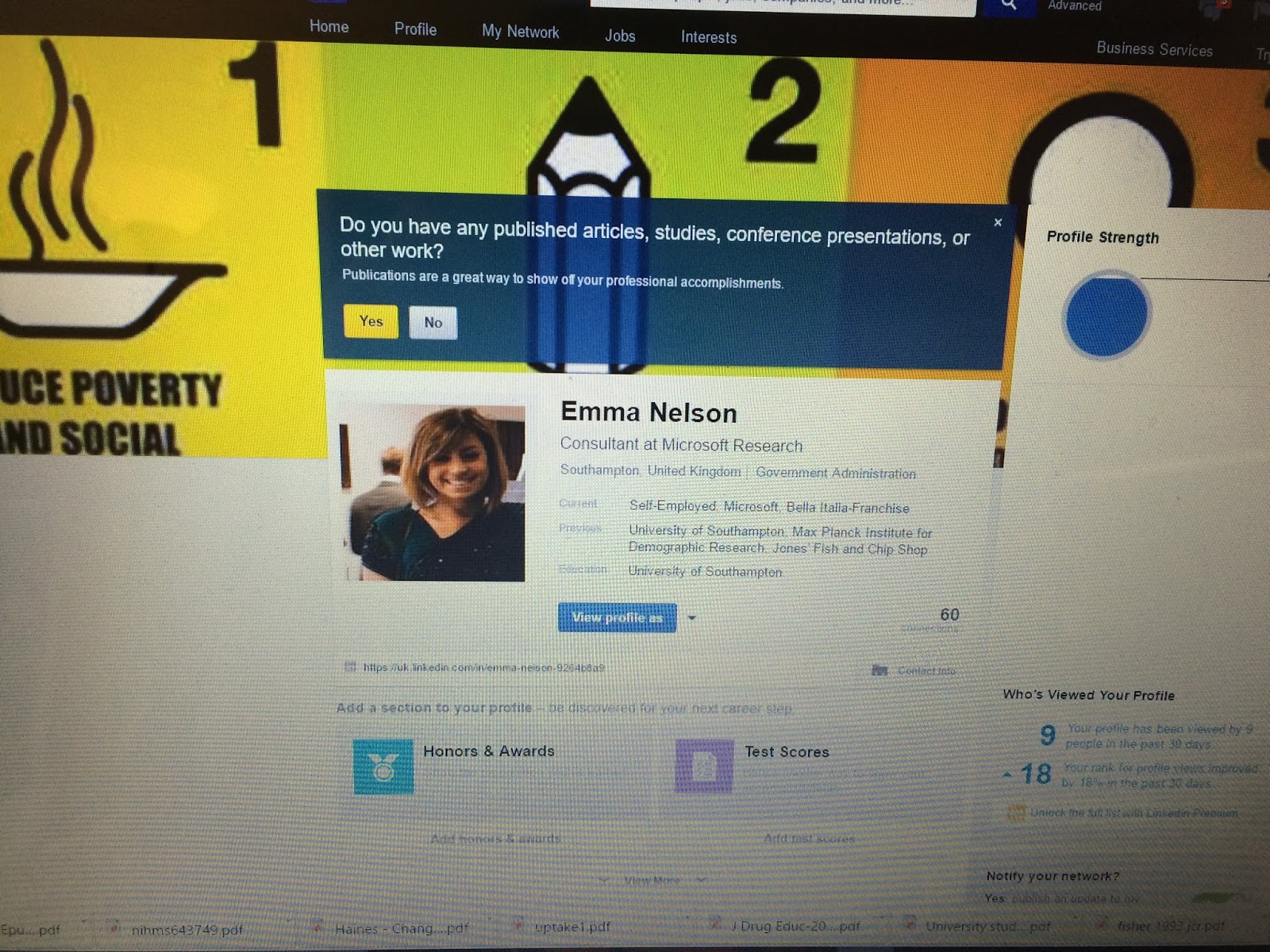
4. Sign up to LinkedIn. While there are discussions about whether or not it is beneficial, it’s free and can’t hurt. Plus it’s essentially an online CV which can be helpful when filling in job applications because you can just copy and paste sections from it!


Plus filling in the profile is a nice way to distract yourself for an hour


My best advice is to do something awesome over summer because, particularly for us postgrads, it’s probably the last chance to have a few totally relaxed weeks without having to worry about work for the rest of our lives – which is a pretty terrifying thought!


Cake – because it’s the only thing keeping me going right now!


Good luck to everyone still working on their exams. Don’t panic because it will all be over soon!

Emma

Tuesday, 17 May 2016

On finishing academia - forever

A few days ago I finished the final paragraph of the final essay of my final year here at the University of Southampton.

After a few touch-ups to the referencing, I logged on to e-assignments (the electronic essay submissions system we use here) for the last time and submitted it, essentially ending my degree.

What came next was a whole cocktail of emotions. I mean, it’s not really officially over until July, when I get to wear a funny hat, collect a rolled-up piece of paper and actually graduate; but from now on, there’s no more work left. Everything that I needed to do in order to make sure that I was allowed to pick up that rolled-up piece of paper is now done.

Obviously, it feels like a gigantic weight has been lifted: I have a degree, all my hard work paid off - I made it through to the end. But then again, I am still left with that slightly deflating “…now what?”. I’m reminded of the most fulfilling experiences during my academic career, both those which I mentioned a few blog posts back, and more recently.

Just last week the Film Festival swept up another accolade - an EVA (Excellence in Volunteering Award), but now suddenly there is very little left to keep me occupied.

So, may I present to you dear reader, a little list of things to keep the brain active during such a time. You might not have finished completely, but rounding off any academic year usually ends up leaving a great deal of blank space behind, so here are some ways to stay motivated.

Use All Your Time


Okay, this first one may seem like a bit of a step backward: the last thing you want to be doing when you finally finish work is to go back and do it all over again. However, in reality, when it comes to something as substantial as this, you really should use all of the time made available to you.

Unless you have some sort of pressing reason to submit your essay ridiculously early, why not use the time to relax a little more and make sure you’ve squeezed your brain entirely dry of ideas? Especially if you simply just plan on transitioning into very little, those extra few days might mean the difference between a lower grade and a higher one.

It’s the final push - you might as well give it all you’ve got!

Make Stable Plans


The deadline has finally past and you’re well and truly done - great! Now what?

Suddenly the world is your oyster. All those long nights cooped up in Hartley Library have finally paid off and now you’re totally free to do whatever you want. The only problem is, there’s almost too much choice.

Going from a very rigidly structured work day to nothing at all can seem insanely jarring for a lot of people, so why not put some solid plans in your diary early on to help steer your freedom? It might be that trip you’ve always wanted to take or that friend you’ve never visited. It could even be something as basic as just going to the cinema. With the plans in place, not only will you definitely get to do everything you’ve been wanting to do the whole way through your work, but you’ll also start to fill your time productively.

Lazing around can be a lot of fun, but it certainly saps your energy levels too. If you don’t start making plans, you might start to see your entire summer gradually fade away before you actually get the chance to fully enjoy it! Which reminds me…


 Pressing that final submit button was certainly very satisfying.


Enjoy Yourself!


True, the points I’ve already mentioned are there to help you maximise your productivity, even when you have little structure. What’s most important of all, though, is that you enjoy yourself. If these ideas don’t work for you, feel totally free to ignore them. You’ve worked insanely hard to get to this point, and you should be allowed to do whatever you so please as a reward.

Eventually, you’re going to have to start fumbling around with jobs, so now’s the time to get some much-needed rest. That might come in the form of making plans and doing things, but it also might end up with you still in bed at lunch time playing Grand Theft Auto in your pyjamas.

The trick is to just take that one thing that you always wanted to be doing whilst you were slaving away over essays, and totally embrace it.

I’ll be honest though, as freeing as it was submitting that final assignment, leaving the University’s Film department has been tough. I wish them all the best for the future, and can’t wait to see them continue to top the League Tables in Film Studies for a good while yet.

Education may be somewhat over, but life still continues.

Ben

Wednesday, 11 May 2016

How to survive an all-nighter (if you have to!)

Okay, so this post is not at all endorsement of ‘all-nighters’. Everyone knows how important sleep is for your concentration and memory. If you’re revising, the only way you can retain information is through your sleep cycle.

However, even the most organised student has to go through staying up late or, even not sleeping at all. Maybe this is because they have not anticipated that that one essay was going to take so long. Perhaps they have forgotten that they had an assignment due the next day in the midst of other coursework and exam prep.

Either way, all-nighters are almost like a rite of passage for students!

In this blog post, I compile a list of 10 student approved* hacks to getting in those extra hours of work especially now that exam season has dawned.


…if a picture had to summarise my exam season, this would be it.


1. Stay clean – shower or splash some water on your face


This is one of the easiest ways to maintain your productivity level. Showering offers a few moments of peace away from your notes. Additionally, it’s the best time to mull over your ideas. Research has shown that when you feel clean, you feel renewed making you more productive.

2. Caffeine is your friend …but vitamin supplements may be your BEST friend


Caffeine and energy drinks are effective in keeping you up and improving focus. However, it is best to make sure to only drink these later on at night. Drinking throughout the day actually reduces their effectiveness. You’re better off keeping yourself awake around the 9pm mark by getting fresh air or going for a quick shower than finishing off a can of energy drink.

On the other hand, taking vitamins won’t offset an unhealthy lifestyle (…such as frequently pulling all-nighters) but you can’t really go wrong by adding antioxidants into your body. Vitamins B is best for memory retention and can be naturally sourced from green veggies such as spinach, broccoli and fruits such as oranges.

3. Turn your break into a gym session


It’s 3pm and you’re already getting lethargic from that sandwich you had for lunch. You need a nap. Well why not shoot two birds with one stone by dropping by at the gym for a half hour session? The Jubilee Sports Centre on Highfield Campus is open until 10pm. Even non-members of the gym can join in selected activities such as swimming, ball sports and fitness classes by paying a one off fee. Did someone say Zumba?!


4. Eat protein, not carbs


Sure, your body needs to release energy throughout the night and although carbs are the most obvious source of this, too much of it can actually make you sleepy. Carbs store energy for later but can even make you sleepier in the short term. Go for protein instead.

5. Don’t get too comfortable


The summer weather is upon us, finally. However, this means that everywhere we go it’s going to be warm and cosy and, simply, fantastic! But not if you want to finish off that Biology report for the next morning.

If you’re working from home, try not to do your work in bed whilst you’re snuggled up to the duvet. You’ll most likely end up snoozing off by the time the birds start chirping outside. On the other hand, now is the time to turn your heating off and open wide those windows to let the cool spring air in! If you’re working on campus, many of the University’s buildings are air-conditioned such as Level 5 in the Hartley Library. Cool off and keep concentrating.

6. Set half an hour goals …and reward yourself once you reach them


Study smarter by giving yourself an incentive to perform your best. Of course, aside from the overall reward of competing that assignment or mastering that equation, the prospect of a chocolate bar or some fresh air can make you word more efficiently.


Why not treat yourself to some karaoke this Friday night? After all, you do deserve a break!


7. Drink water


Staying hydrated can help you stay awake by keeping your body feel refreshed. At the same time, it will keep you from dozing off by making you visit the bathroom more often.

8. Chew gum


Ultimately, the key hack to staying up all night is making sure that you stimulate your senses at all times. I find that keeping my mouth busy by chewing some gum keeps me alert.

9. Get a study buddy


Study buddies can help develop understanding, learning and confidence. Have you ever explained a concept to a friend and thought to yourself  'wow, I didn’t realise I knew that much!' If you don’t understand a concept, asking someone for help not only boosts your confidence in knowing that you have someone on your side but asking, in general, is a big part of having a growth mind-set.
Besides, at the 3am mark, it helps to have someone poking you from sleep.

10. The best tip of all: start early and stop procrastinating so you simply just don’t have to do it!


Here are just some of my tips for when I’m in desperate need for more time to work. The point of this blog is give you some help. It is definitely not to encourage you to stay up all night in a desperate attempt to get that paper in the next day. It’s not healthy at all.

But, we’re students and, like I said, sometimes, these situations are just something that we have to go through.

If you have any tips on hacking all-nighters, why not comment below? Good-luck with exams and coursework!

Rylyn

*…self-approved by the author through past experience…

Monday, 9 May 2016

My top five favourite ways to procrastinate during exam season

For the (hopefully) last time in my University career, I am preparing for my exams. Being a postgraduate student, I find myself in an oddly calm yet panicked state. Part of my brain tells me not to worry; that I’ve done this so many times now that I’ve got it. The other half seems hell bent on making me a shaking panicked mess. Thankfully, neither side has won and this has resulted in me working feverishly for a few hours before taking a break and doing some A* procrastination.

Not everyone can work this way, and I certainly wouldn’t advise it unless you have practice. Over the past four years I’ve worked hard on being able to work quickly and efficiently, getting the job done but leaving myself time to do whatever else I want. However, whatever your working and revising style, all of us are guilty of procrastination at various levels.

The basic form is just zoning out in front of your screen for 20 minutes contemplating your own existence, and the extreme form is leaving the country for a weekend break in Frankfurt (as my friend is doing right now) insisting that you will work on the plane.

Considering this, I have compiled my five favourite ways to procrastinate, because they actually help me to work harder when I do get back to revision.

1. Lunch with family and impromptu dinner parties


I rarely see my relatives, but since my sister moved to Oxford it’s become a convenient halfway point between me in the South and my family in the Midlands. Yesterday I took the train to Oxford (actually spending as much time on the train as I did in the city) for a gorgeous lunch with my mum, aunt and youngest cousin.

Taking a day out is a great way to refresh your brain and supply a bit of extra panic to persuade you to work harder the next day. If you’re bored of revising, chances are your friends are too, so arrange to get together for some non-study related time and try and resist asking each other about coursework!


Oxford in the early May sunshine


Steak tastes better when you don’t have to pay for it


2. Napping


I love to nap and when I’m home all day sat at my desk, napping is my favourite escape from work. It doesn’t even matter how long I nap for, it can be 20 minutes or two hours but the effect is like rebooting your computer. I have more energy and feel more enthusiastic about working after some much-needed shut eye.

3. Playing guitar


I’m pretty sure there’s some science regarding playing musical instruments as a way of productively procrastinating. Guitars and keyboards can be cheap and don’t take up much space, and playing music gives you a sense of accomplishment, whilst also being pretty relaxing.

4. Cooking/Baking


Again, this is perfect productive procrastination. Spend some quality time in your kitchen and learn to make a new dish or get creative with something you already know how to do. Cooking is a great excuse to close the books for an hour or two and you can set up a laptop/tablet in the kitchen with you and watch something on Netflix whilst you’re doing it.

5. Work on your favourite piece of coursework/exam


Usually I dedicate the most time to the subjects I find the hardest and the least to the ones I really enjoy. Working isn’t really procrastination, but sometimes when I’m working on an essay that I’m really in to, I get the same feeling that I should be working on something else that’s harder and with an earlier deadline.

However, all of it needs to be done in the end and by using your favourite subject as a reward for working on the harder ones, you feel much happier about still being sat at the computer after six hours!

The things we all need to stay away from are definitely sitting down and just binge-watching TV shows or mindlessly scrolling through Facebook.

Good procrastination means giving your brain a rest from work by distracting it with something else that you find interesting. If you switch off completely it’s hard to switch back on.

Good luck with exam season everyone!

Emma 

Wednesday, 27 April 2016

How to stay healthy during exam season

Healthy living as a student is tough at the best of times. When I was an undergraduate, my main form of exercise was dancing on nights out and I considered chocolate and instant noodles key food groups. This last year I have been trying to live healthier (partly because I study Global Health - learning about health makes it easier to live healthier). I joined the gym and started cooking healthier food.

However, staying healthy during the exam period? Forget about it. When I'm stuck at home or the library all day and stressed out by coursework deadlines, making sure I'm getting my five a day and spending time cooking is so low down on my list.

In an effort to figure out how to live healthier during exams, I asked some fellow postgraduate students for their top tips for staying healthy during exam season. Hopefully this list helps other people who face the same struggle as me!

1. Stay hydrated! 


It's so easy to forget or neglect to bring a water bottle to the library with you, especially when you are carrying your own weight in books and a laptop, but if I don't bring any water with me then I won't be able to work for long before I end up with a headache.

2. Buy carrots.  


This one really surprised me but it does make sense. Carrots are one of those healthy foods that you can eat raw and a friend of mine really rates them as a great stress food because you can reach for them when you would normally reach for a chocolate bar.

Okay…so maybe they aren't as satisfying in terms of sugar, but they fulfil that desire to just eat something which seems to affect all of us when we are stressed out. Fruit works too but one advantage of carrots is that they don't get bruised in your bag and they have a longer sell by date which means you are less likely to have to throw them out because they've gone off.


The ultimate comfort food – must resist!


3. Do the weekly shop online.  


The logic for this is absolutely brilliant. Firstly, walking round a supermarket is a total time eater; I know when I go shopping even when I have a list it ends up taking me at least an hour, plus getting there and back during exams and coursework. I just don't have that time spare. Doing the shop online is much more time efficient which can totally help stress as well.

However, the main way it helps you stay healthy is that supermarkets are very good at marketing junk food to customers. As soon as you walk in you see muffins or cookies on offer, and then you walk around and see more goodies on sale. By shopping online, they can't tempt you with sweet and sugary food and instead you can just buy what you actually need. Plus, you can almost always arrange a delivery time that suits you perfectly.

4. Don't forget your friends. 


Revision and working on coursework can be quite isolating, and often you feel it's something you can only do on your own. However, study groups can be an amazingly helpful way to learn and by staying social and getting you out of the house. Even just meeting up to chill out is a good idea – there can be a life outside of exams!


Celebrating the end of teaching with the public health lot. 


Remember that health is not just exercising and eating right. During these intense study periods levels of stress are higher and we have a tendency to stop looking after ourselves in favour of just getting work done. However, this doesn't necessarily work, as the less healthy you are the less productive you are.

I will definitely be trying these four tips for staying healthy, and hopefully these ideas inspire you to find your own ways of staying healthy to ensure the most successful exam season possible.

Emma